
Main Street vs. Wall Street: The Double Standard in Business Support
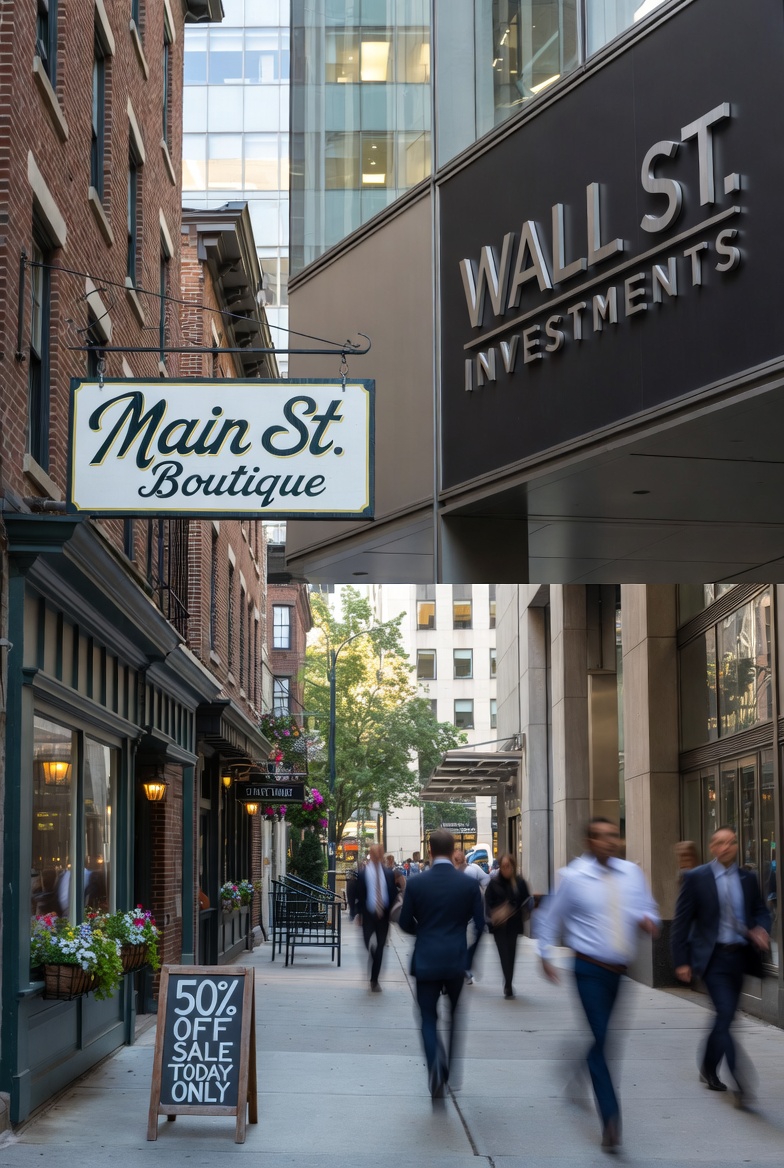
Welcome back to the blog, where we delve deeper into the conversations we’re having on the podcast. In our latest episode, Subsidies, Strings, and Small Business: Inside the SBA Maze, we tackled a critical issue that affects entrepreneurs and local economies everywhere: the perceived double standard between how Wall Street giants and Main Street businesses are treated by our financial and governmental systems. This disparity isn't just an abstract concept; it erodes trust, stifles innovation, and directly impacts the vitality of the communities that small businesses anchor. Today, we’re going to expand on that theme, dissecting the mechanisms that create this divide and exploring its far-reaching consequences.
Main Street vs. Wall Street: Defining the Divide
The terms "Main Street" and "Wall Street" have become shorthand for two distinct economic worlds. Main Street represents the backbone of local economies – the independent shops, restaurants, service providers, and small manufacturers that form the fabric of our communities. These are the businesses owned by our neighbors, employing our friends, and contributing directly to the unique character of our towns. They are often characterized by personal relationships, local investment, and a direct connection to the people they serve. They operate with limited resources, relying on ingenuity, hard work, and community support to thrive. Their growth is typically organic, built on a foundation of customer loyalty and sustainable practices.
Wall Street, on the other hand, typically refers to the major financial institutions, large corporations, and investment firms that dominate the global financial landscape. These entities operate on a massive scale, with access to vast capital, sophisticated financial instruments, and significant lobbying power. Their operations are often complex, driven by shareholder value, and influenced by global market forces. While they are crucial to the broader economy, their primary focus is often on maximizing returns for investors, which can sometimes lead to decisions that prioritize profit over community impact or ethical considerations.
The perceived double standard emerges when we observe how these two worlds are treated, particularly during times of economic distress or when seeking support. Main Street businesses often face stringent requirements, limited access to capital, and a complex bureaucratic maze when seeking assistance. Wall Street firms, in contrast, have historically demonstrated a remarkable ability to secure substantial bailouts and favorable treatment, even when their risky practices have contributed to economic instability. This disparity in access and treatment is a core grievance for many small business owners and forms the central thesis of our discussion.
How the System Favors Wall Street
Several factors contribute to the systemic advantages enjoyed by Wall Street. Firstly, their sheer size and financial clout allow them to command attention and leverage. Large corporations can afford dedicated teams of lawyers, lobbyists, and financial experts to navigate complex regulations and negotiate favorable terms. They have the resources to weather economic downturns more effectively and can often withstand periods of low profitability due to their diversified revenue streams and substantial reserves.
Secondly, the interconnectedness of the global financial system means that the failure of a major Wall Street institution can have catastrophic ripple effects across the entire economy. This systemic risk often necessitates government intervention and bailouts, as policymakers prioritize the stability of the larger financial ecosystem. While intended to prevent widespread collapse, these interventions can be perceived as rewarding risky behavior and creating a moral hazard, where institutions take on greater risks knowing they are likely to be rescued if things go wrong.
Furthermore, Wall Street firms often benefit from existing regulations and tax structures that can be more advantageous to large, complex organizations. Tax loopholes, preferential capital gains treatment, and the ability to engage in sophisticated financial engineering can all contribute to greater profitability and access to capital. The sheer volume of financial transactions and the complexity of the instruments involved also mean that these firms are often operating in a regulatory environment that, while intended to provide oversight, can also be navigated more effectively by those with the resources to do so.
The Impact on Main Street Businesses
The disadvantages faced by Main Street businesses are manifold and can have a devastating impact on their ability to start, grow, and survive. When compared to the seemingly effortless access to resources enjoyed by their Wall Street counterparts, the struggles of local entrepreneurs become starkly apparent. This creates a cycle of limited opportunity and persistent challenges.
One of the most significant hurdles is access to capital. Traditional banks often view small businesses as higher risk, demanding substantial collateral, rigorous business plans, and proven track records. This can be a significant barrier for new ventures or businesses in their early growth stages. Even when seeking loans or investment, the paperwork and approval processes can be lengthy and arduous, often leading to missed opportunities or desperate measures.
Beyond financing, Main Street businesses often struggle with the costs of compliance and the complexity of government programs. While these programs are often designed with the intention of supporting small businesses, the administrative burden can be overwhelming. Navigating grant applications, understanding loan terms, and meeting reporting requirements can divert valuable time and resources away from core business operations. This is particularly challenging for sole proprietors or small teams where every individual wears multiple hats.
The psychological toll of this disparity is also significant. Constantly witnessing or hearing about large corporations receiving substantial government support, while their own efforts are met with roadblocks, can lead to disillusionment and a sense of injustice. This can stifle entrepreneurial spirit and discourage individuals from pursuing their business dreams, ultimately weakening the local economic base.
Examining SBA Programs: The Intended vs. The Reality
The Small Business Administration (SBA) is a government agency established with the explicit mission of supporting small businesses. Its programs are designed to provide a bridge to financing, offer counseling and resources, and help small businesses compete. However, as we explored in our related episode, the reality of these programs often falls short of their noble intentions, creating a landscape where opportunity can be hijacked by those who exploit the system rather than benefit from it genuinely.
PPP & EIDL: Emergency Measures and Unintended Consequences
The Paycheck Protection Program (PPP) and Economic Injury Disaster Loans (EIDL) were created as emergency measures during the COVID-19 pandemic to provide immediate financial relief to businesses struggling to stay afloat. The intention was to quickly inject capital into the economy and prevent mass closures. However, the speed and scale at which these programs were implemented, coupled with a lack of robust oversight, created significant openings for fraud and abuse.
We heard stories and evidence of "paper" small businesses, shell corporations, and individuals with no legitimate operations applying for and receiving funds. This not only siphoned off billions of taxpayer dollars but also meant that legitimate businesses, those who truly needed the support and followed the rules, often faced delays, bureaucratic hurdles, and ultimately, received less assistance than they deserved, or none at all. The fraud didn't just steal money; it stole trust from the very system designed to provide a safety net. This created a bitter irony: businesses struggling to keep their doors open watched as others seemed to profit from the crisis through dishonest means.
SBA 7(a) and 504 Loans: Promises and Pitfalls
The SBA 7(a) loan program is the SBA's flagship lending program, providing guarantees to lenders that reduce their risk when lending to small businesses. The SBA 504 loan program focuses on providing long-term, fixed-rate financing for major fixed assets, such as real estate and equipment. These programs are designed to make it easier for small businesses to obtain crucial funding for expansion, equipment purchases, and working capital.
In theory, these programs offer a lifeline. A guaranteed loan means a bank is more likely to say "yes" when they might otherwise say "no." This can be transformative for a growing business that needs capital to hire more employees, purchase essential machinery, or expand its facilities. However, the episode highlighted how these guarantees can be influenced by weakened underwriting standards or intentional neglect of due diligence. When the focus shifts from the viability of the business to the perceived safety of the guarantee, the system can become less about supporting genuine growth and more about facilitating transactions, sometimes with questionable borrowers.
Furthermore, the valuation of assets and the projections for future profitability are critical components of these loan applications. When these elements are not rigorously examined, or when projections are overly optimistic to secure funding, it can lead to inflated loan amounts that may not be sustainable for the business in the long run. This can ultimately lead to defaults, further straining the system and disadvantaging legitimate borrowers who are assessed more stringently.
Set-Asides and 8(a) Programs: Opportunity or Exploitation?
Government contracting plays a vital role in supporting small businesses, and programs like set-asides and the 8(a) Business Development program are designed to ensure that a portion of government contracts goes to small, disadvantaged, or minority-owned businesses. The intention is to level the playing field and provide opportunities for firms that might otherwise be overlooked by larger contractors.
The 8(a) program, in particular, aims to help small disadvantaged businesses compete in the federal marketplace. However, the episode pointed out how these programs can be exploited through "pass-through" schemes and "front" companies. In these scenarios, individuals or entities that do not genuinely meet the criteria for a small or disadvantaged business use legitimate small businesses as a front to win contracts. The profits are then siphoned off, or the work is subcontracted to larger, ineligible firms. This "steals" real opportunity from honest firms that have invested in building legitimate capabilities and meeting the program's requirements. It undermines the integrity of the program and perpetuates the idea that success is achieved through manipulation rather than merit.
The Erosion of Trust and Local Economies
When small business owners witness or experience these systemic failures, the erosion of trust is profound. They see a system that, in practice, seems to favor the wealthy and well-connected, while placing undue burdens on those who are the true builders and innovators in their communities. This fosters a sense of cynicism and discouragement, making them question whether playing by the rules is truly the best strategy for success.
This erosion of trust has tangible consequences for local economies. If entrepreneurs feel the system is rigged against them, they may be less likely to start new businesses, expand existing ones, or invest in their communities. This can lead to stagnation, reduced job creation, and a decline in the economic vitality of towns and cities. The unique character and resilience of Main Street businesses are essential for healthy local economies, and when they are undermined, the entire community suffers.
Moreover, the perception that large corporations and financial institutions can operate with a degree of impunity while small businesses face intense scrutiny can lead to broader societal dissatisfaction. It fuels the narrative of an uneven playing field and can contribute to a general distrust of government and financial institutions. This distrust makes it harder for these institutions to enact policies that genuinely benefit the public, as well intentioned initiatives can be met with skepticism and resistance.
What Does "Real" Reform Look Like?
The path forward requires a fundamental reevaluation of how our support systems for businesses are structured and enforced. As discussed in the episode, genuine reform needs to move beyond superficial changes and address the root causes of the disparities. This includes:
- Modern Verification and Transparency: Implementing robust, technology-driven verification processes to ensure that only eligible businesses receive support. Increased transparency in the allocation of funds and contracts would allow for greater public scrutiny and accountability.
- Real Ownership and Control Enforcement: Stricter enforcement of regulations regarding true ownership and control of businesses seeking government support. This would combat the use of front companies and ensure that benefits go to those genuinely intended.
- Lender Accountability: Holding financial institutions accountable for their role in the lending process. This includes ensuring rigorous underwriting standards and penalizing lenders who facilitate fraudulent activities or exploit loopholes.
- Contract Performance Audits: Regularly auditing the performance of businesses that receive government contracts, particularly those awarded through set-aside programs. This ensures that work is being performed as promised and that the contracts are delivering value.
- Real Consequences for Cheaters: Implementing meaningful and swift penalties for individuals and entities that engage in fraud, abuse, or exploitation of support programs. This includes fines, debarment from future government contracts, and, where appropriate, criminal prosecution.
- Streamlining Processes for Legitimate Businesses: While strengthening oversight, it's also crucial to simplify and expedite application and approval processes for genuine small businesses. This means reducing unnecessary red tape and providing clearer guidance and support.
- Focus on Community Impact: Shifting the focus of some support programs to prioritize businesses that demonstrate a clear commitment to job creation, local economic development, and community well-being.
These reforms are not about creating new programs but about ensuring that existing ones function as intended – as ladders of opportunity for honest builders, not as playgrounds for grifters and insiders. It’s about restoring faith in the system by demonstrating that it can be fair, effective, and truly supportive of the entrepreneurs who keep our communities vibrant.
Conclusion: Restoring Fairness for Main Street Entrepreneurs
The conversation we had in Subsidies, Strings, and Small Business: Inside the SBA Maze and expanded upon here is a crucial one. The perceived double standard between how Wall Street and Main Street businesses are treated is not just a matter of perception; it is a systemic issue with tangible consequences for our economy and our communities. The erosion of trust that stems from this disparity can have a chilling effect on entrepreneurship and economic growth.
The SBA, intended as a powerful tool to level the playing field, has, in practice, been subject to exploitation. While emergency measures like PPP and EIDL were necessary, their execution revealed significant vulnerabilities that were exploited by those looking to game the system. Even established programs like 7(a) and 504 loans, along with contracting set-asides, can become avenues for abuse if not rigorously overseen. This leaves genuine, hardworking Main Street entrepreneurs feeling overlooked and disadvantaged.
Restoring fairness requires a commitment to genuine reform – not just more programs, but better enforcement, increased transparency, and real accountability. When Main Street businesses are treated with the same seriousness, competence, and fairness that have historically been afforded to Wall Street, we unlock the true potential of our local economies. This is about ensuring that the ladder of opportunity remains accessible for honest builders, and that those who seek to exploit the system are held to account. Thank you for joining us in this deeper dive, and we encourage you to listen to the episode for the full discussion. Your engagement and stories are what make this conversation so vital.